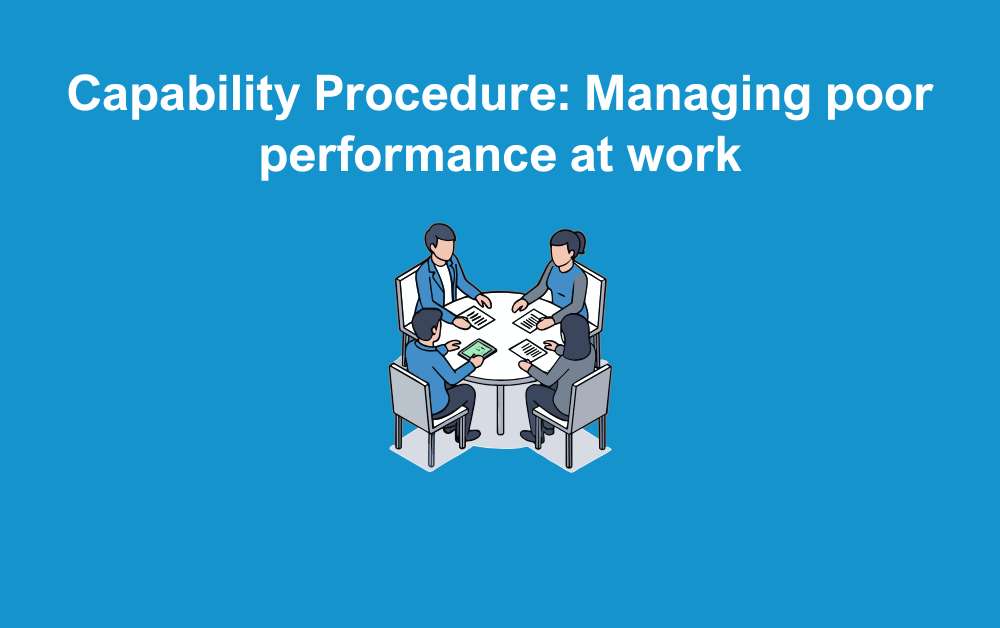
Managing underperformance is a familiar challenge for employers, and deciding whether to use a disciplinary or capability procedure can feel confusing. Getting this wrong can lead to unnecessary conflict, poor morale, and legal risk. A clear, fair, and well-communicated capability process helps employers support staff to improve, protect business performance, and reduce the likelihood of an employment tribunal.
In this article, we will explore what a capability procedure is, the difference between disciplinary and capability, and how to handle this correctly.
What does capability mean?
Capability refers to an employee’s ability to do their job to the required standard. It usually relates to skill, competence, health, or any other physical or mental quality required to do their job. An employer may decide on capability process due to the employee struggling with workload, not fully trained, unclear on expectations, or dealing with personal difficulties.
Capability versus disciplinary procedures
Employers often ask whether underperformance should be handled through the disciplinary route. The key difference lies in intent.
Capability procedures are used when:
- An employee is trying but not meeting expectations
- There is a skills or knowledge gap
- There are health-related reason for performance being affected
Disciplinary procedures are used when:
- An employee is deliberately failing to follow rules
- There is misconduct or negligence
- There is a refusal to carry out reasonable instructions
Capability should be the default approach for genuine performance challenges.
How to monitor capability effectively
There are many ways to monitor performance. To performance is at the highest standard, it’s important to share clear expectations during the onboarding process. This includes:
- Setting clear, measurable performance expectations
- Providing regular feedback and one-to-one meetings
- Keeping accurate records of concerns and support offered
- Offering additional training, mentoring, or reasonable adjustments
- Allowing time for improvement and reviewing progress fairly
This approach ensures the employee knows what needs to change and helps the employer evidence a fair process if a situation escalates to a capability procedure.
Why capability procedures matter
A well-run capability process:
- Helps employees understand expectations and develop skills
- Protects business productivity and team morale
- Demonstrates fairness and consistency across the workforce
- Reduces the risk of claims for unfair dismissal
- Shows that the employer has given the employee every reasonable opportunity to improve
Capability procedures are not simply a route to termination. They are a structured way to support improvement.
What a capability procedure typically looks like
A fair capability procedure usually includes:
-
Identifying concerns
Gather examples of performance issues and discuss them with the employee. -
Informal support
Offer guidance, training, mentoring, or adjustments. Document anything agreed. - Conduct an Investigation
Fact-finding exercise to discover why they are underperforming. This can include gathering evidence of poor executed work, past appraisals, or customer complaints. -
Formal capability meeting
If there is no improvement, invite the employee to a meeting to review concerns and set an improvement plan. Allow the employee to be accompanied. -
Performance improvement plan
Set clear objectives, timescales, and support measures. Review regularly. -
Further review meetings
Continue to meet during the review period to track progress. -
Outcome
If performance improves, confirm the positive outcome. If not, consider further steps such as extending the plan, redeployment, or dismissal as a last resort.
This is a way to manage and monitor staff performance. If you are investigating an employee’s ill health capability procedure, you should follow GDPR, DPA, and Access to Medical Reports Act rules first.
Why capability procedures are Important
This process is an important way to monitor employee performance and identify if it’s a good match for both parties. If you have identified any performance issues, you are able to work on this before it impacts the business and workplace. Benefits include:
- Helps employees understand expectations and develop skills
- Protects business productivity and team morale
- Demonstrates fairness and consistency across the workforce
- Reduces the risk of claims for unfair dismissal
- Shows that the employer has given the employee every reasonable opportunity to improve
Capability procedures are not simply a route to termination. They are a structured way to support improvement.
It gives you the opportunity to work with your staff and look at ways to strengthen their performance. Taking time to fix the performance issue will allow you to save on recruitment costs, and show employees that you want to give them the opportunity to thrive in the business. This will help you build trust and loyalty in the future.
The worst thing you can do is to create unnecessary stress or pressure.
How to reduce the risk of an employment tribunal
You should always follow a fair process when managing capability issues, as skipping steps can result in unfair dismissal claims. You’ll also need to show that any decision to dismiss on capability grounds was reasonable and supported by a proper procedure.
If the situation involves health concerns, take extra care to avoid disability discrimination. Treating a disabled employee less favourably, or failing to consider adjustments, can lead to further claims.
Tribunals often look at whether the employer behaved reasonably. To protect your organisation:
- Use the capability route for genuine performance issues
- Apply processes consistently across staff
- Keep detailed written records
- Offer appropriate training and adjustments
- Allow a reasonable timescale for improvement
- Follow your policy and a fair process
- Communicate clearly and listen to the employee’s perspective
A fair and transparent process is the best defence against claims.
Final thoughts
Dealing with poor performance can be challenging, but a thoughtful capability process gives employees the chance to succeed while helping employers maintain high standards. By choosing the right procedure and supporting staff through it, businesses can resolve issues constructively and avoid unnecessary legal risks.
How The HR Booth can help
Navigating a capability procedure can be time consuming and stressful, especially when you are trying to balance fairness with the needs of the business. The HR Booth provides practical, hands-on support to guide you through every stage of the process. We can help you assess whether the issue is a capability or disciplinary matter, prepare documentation, draft performance improvement plans, and support you in meetings. Our team also works with you to build clear policies, train line managers, and make sure your approach follows best practice and legal requirements. With our guidance, you can manage performance concerns confidently, protect your business, and reduce the risk of disputes.